
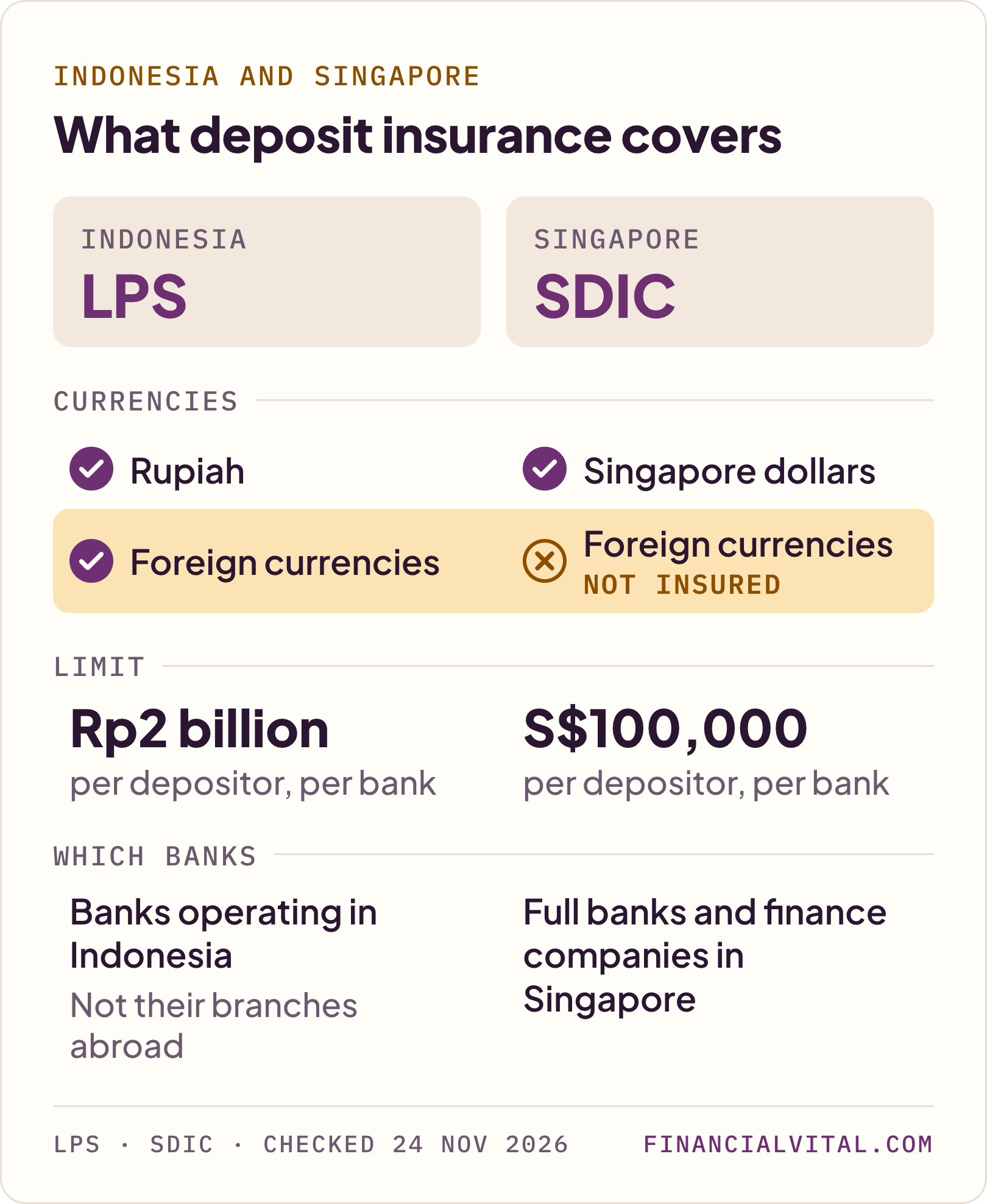
At home, LPS guarantees deposits in rupiah and in foreign currencies. Singapore’s scheme works differently: it covers Singapore-dollar deposits only, up to S$100,000 per depositor at each bank. A US-dollar or rupiah balance in a Singapore bank has no deposit insurance.
What’s different in Singapore
In Indonesia, LPS (the Indonesia Deposit Insurance Corporation) guarantees up to Rp2 billion per depositor at each bank. That covers rupiah and foreign-currency deposits, as long as the deposit is recorded in the bank’s books, earns no more than LPS’s guarantee rate, and the depositor hasn’t been involved in wrongdoing that harmed the bank.
In Singapore, SDIC (the Singapore Deposit Insurance Corporation) insures up to S$100,000 per depositor at each bank in its Deposit Insurance Scheme. It covers Singapore-dollar deposits only. Foreign-currency deposits get no deposit insurance, whatever the amount.
Two more differences matter if you bank in both countries:
- Indonesian banks’ branches abroad are outside LPS. LPS doesn’t cover an Indonesian bank’s branch in Singapore. In Singapore, only full banks and finance companies are scheme members, so check SDIC’s list for that exact bank.
- Your passport doesn’t decide it. SDIC covers individuals and organisations such as companies. The Act behind the scheme sets no nationality or residence condition.
What is covered, and what isn’t
Covered, in Singapore dollars only:
- Savings accounts
- Current accounts
- Fixed deposits
Not covered:
- Foreign-currency deposits, such as US dollars or rupiah, in any type of account
- Structured deposits and structured notes
- Investment products, such as unit trusts, shares and other securities
To see what is insured at your bank, look for the deposit insurance statement on its account forms and statements, or ask for its register of insured deposits.
How the S$100,000 limit works
- Per depositor, per bank. All your insured SGD deposits at one scheme member are added together, across all its branches, and covered up to S$100,000. Deposits at different scheme members are covered separately, up to S$100,000 at each.
- Joint accounts are split equally between the holders, unless the bank’s records show otherwise. Each share is added to that person’s other deposits at the same bank.
- Business owners. A company is a depositor in its own right. A sole proprietor’s business deposits are added to their personal deposits at the same bank.
- It’s automatic. You don’t apply or pay a premium. If a scheme member fails, you don’t need to file a claim: SDIC aims to pay most depositors within seven working days after MAS starts the payout.
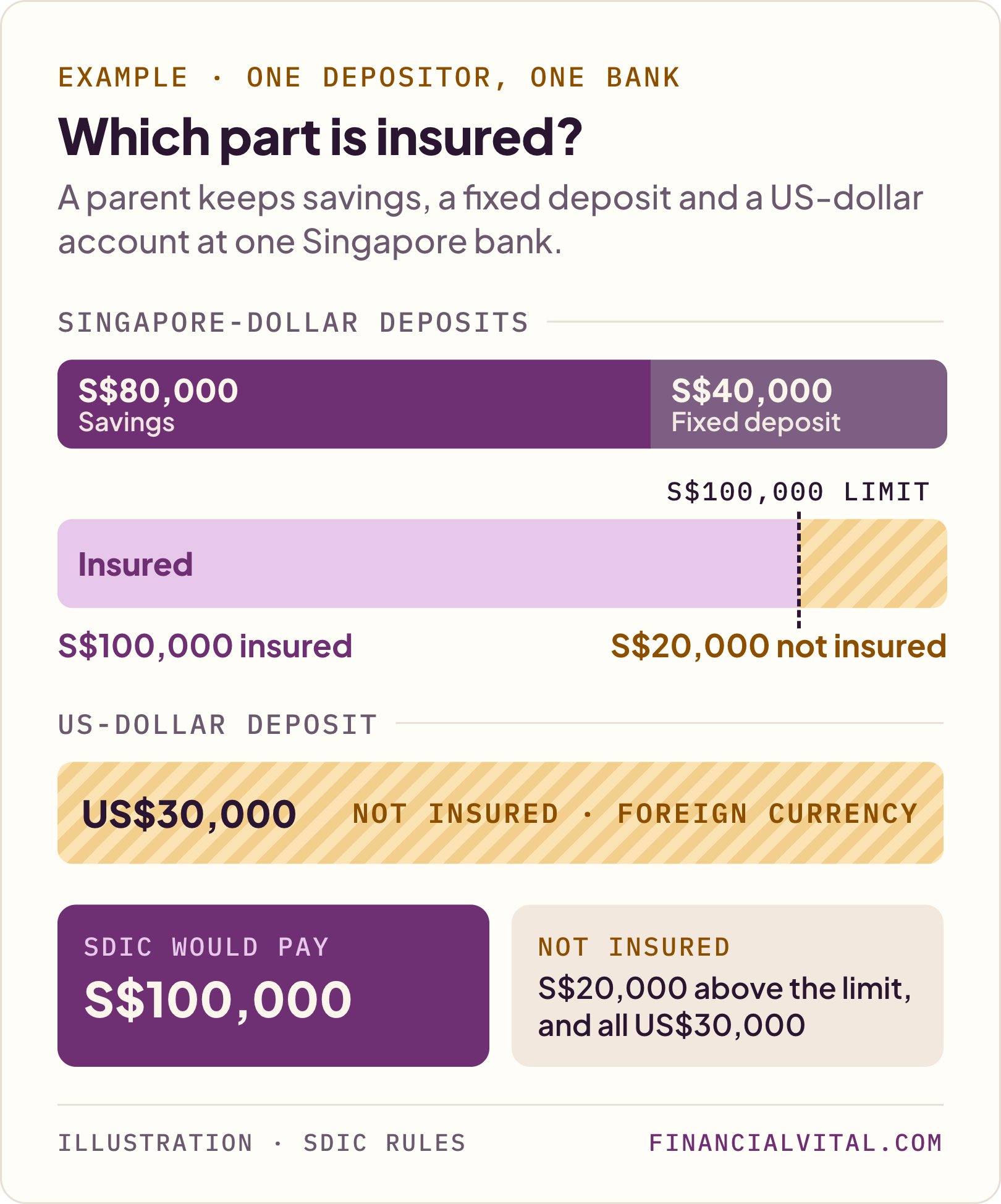
Example: at one Singapore bank, a parent holds S$80,000 in savings, S$40,000 in a fixed deposit and US$30,000 in a foreign-currency account. SDIC would cover S$100,000. The other S$20,000 and the whole US$30,000 are not insured.
Check your own cover
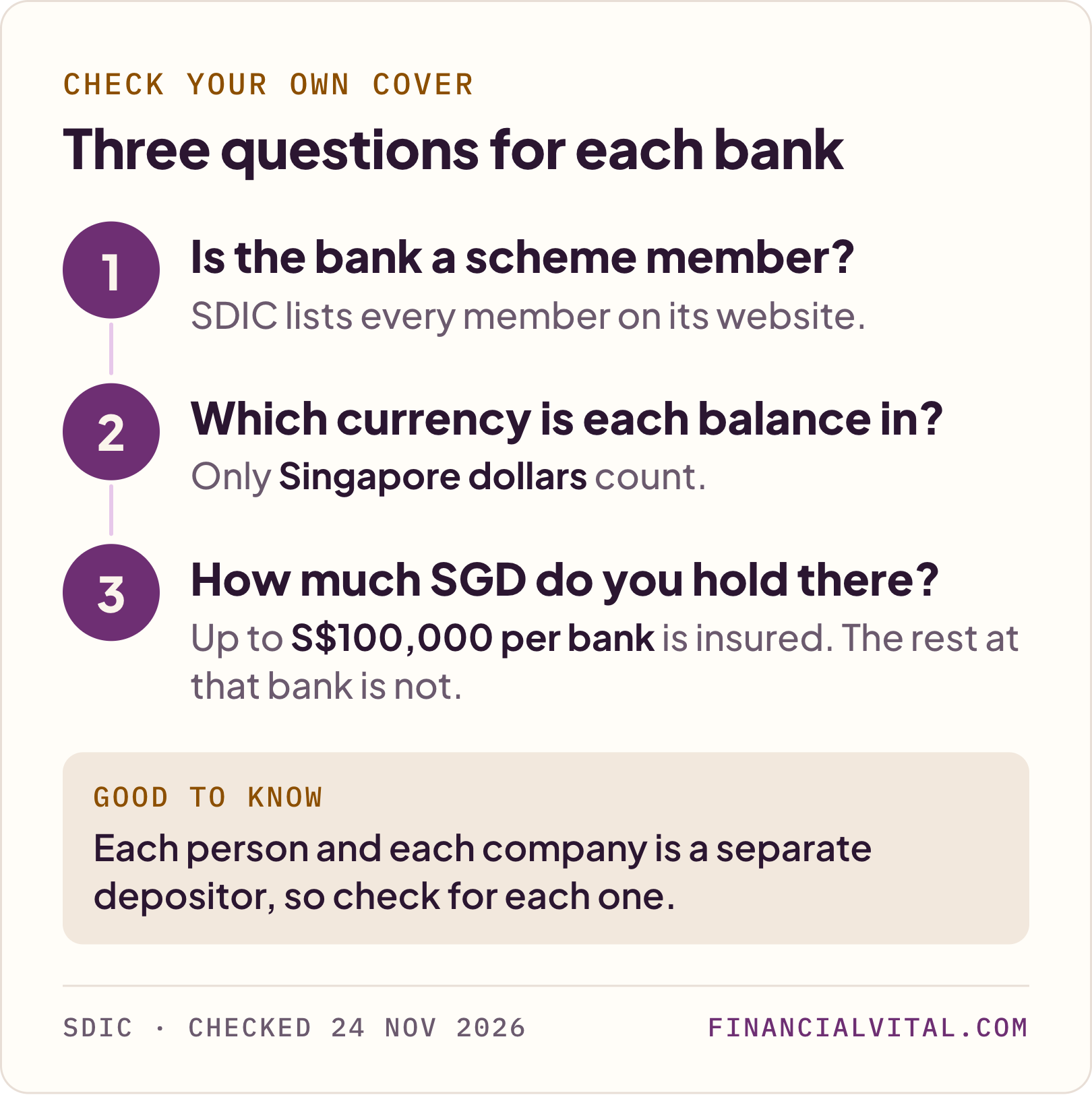
- Is the bank a scheme member? SDIC’s website lists every member.
- Which currency is each balance in? Only Singapore-dollar deposits count.
- How much SGD do you hold at each bank? Up to S$100,000 per bank is insured. Anything above that at the same bank is not.
Do this for each person and each company that holds accounts, because each one is a separate depositor.
What deposit insurance doesn’t do
Deposit insurance pays out only if a scheme member fails. It doesn’t protect you from exchange-rate moves, scams or falls in the value of investments.
Where and in which currency you keep money also involves exchange rates, access and fees. Deposit insurance is one part of that picture. If you keep an emergency fund in Singapore, it helps to know which part of it is insured.
Learn with others
Questions about managing money between Indonesia and Singapore? Join the Financial Vital community to learn alongside other Indonesian families and business owners.
Sources
All checked on 24 Nov 2026.
- SDIC: Scope of deposit insurance coverage: who and what is insured; what is not
- SDIC: Calculation of compensation: the S$100,000 limit per depositor per member, joint accounts, sole proprietors, US-dollar deposits
- SDIC: Deposit Insurance Scheme members: all full banks and finance companies, unless MAS exempts them
- SDIC: Frequently asked questions: companies covered, automatic cover, seven-working-day payout target
- SDIC: Deposit insurance payout: no claim needed
- MoneySense: Understanding deposit insurance: structured notes; deposit insurance statements and registers
- MAS Notice DIA-N01 (Amendment) 2023: limit raised to S$100,000 from 1 April 2024
- Deposit Insurance and Policy Owners’ Protection Schemes Act 2011, section 2: who counts as an insured depositor
- LPS: Simpanan yang dijamin: LPS’s three conditions
- LPS: FAQ: Rp2 billion per depositor per bank; Indonesian banks’ branches abroad not covered
- LPS Regulation No. 1 of 2023, articles 29 and 38: the Rp2 billion limit; foreign-currency claims paid in rupiah