
A Singapore bank account makes it easier to pay school fees, rent and bills in Singapore dollars, and to keep part of an emergency fund where you need it. Each bank sets its own rules for non-residents, so the best preparation is knowing what to check and what to ask. This workflow doesn’t name or compare banks.
What’s different in Singapore
Every bank checks who you are. Under MAS rules, banks must identify and verify each customer. Expect to show your passport and give details such as your address and what the account is for.
Every bank asks where you’re a tax resident. Under the Common Reporting Standard, banks in Singapore must establish the tax residence of all their account holders, usually with a self-certification form. They report the accounts of tax residents of partner countries to IRAS, Singapore’s tax authority, which exchanges the information with those countries.
Deposit insurance covers Singapore dollars only. Up to S$100,000 per depositor at each bank (see Singapore insures SGD deposits only).
Quiet accounts can be frozen. Under the banks’ consumer code, a bank may freeze or restrict an account that has been inactive for the period set in its terms, and fall-below fees can still apply. The bank should tell you how to keep it active or reactivate it.
Step by step
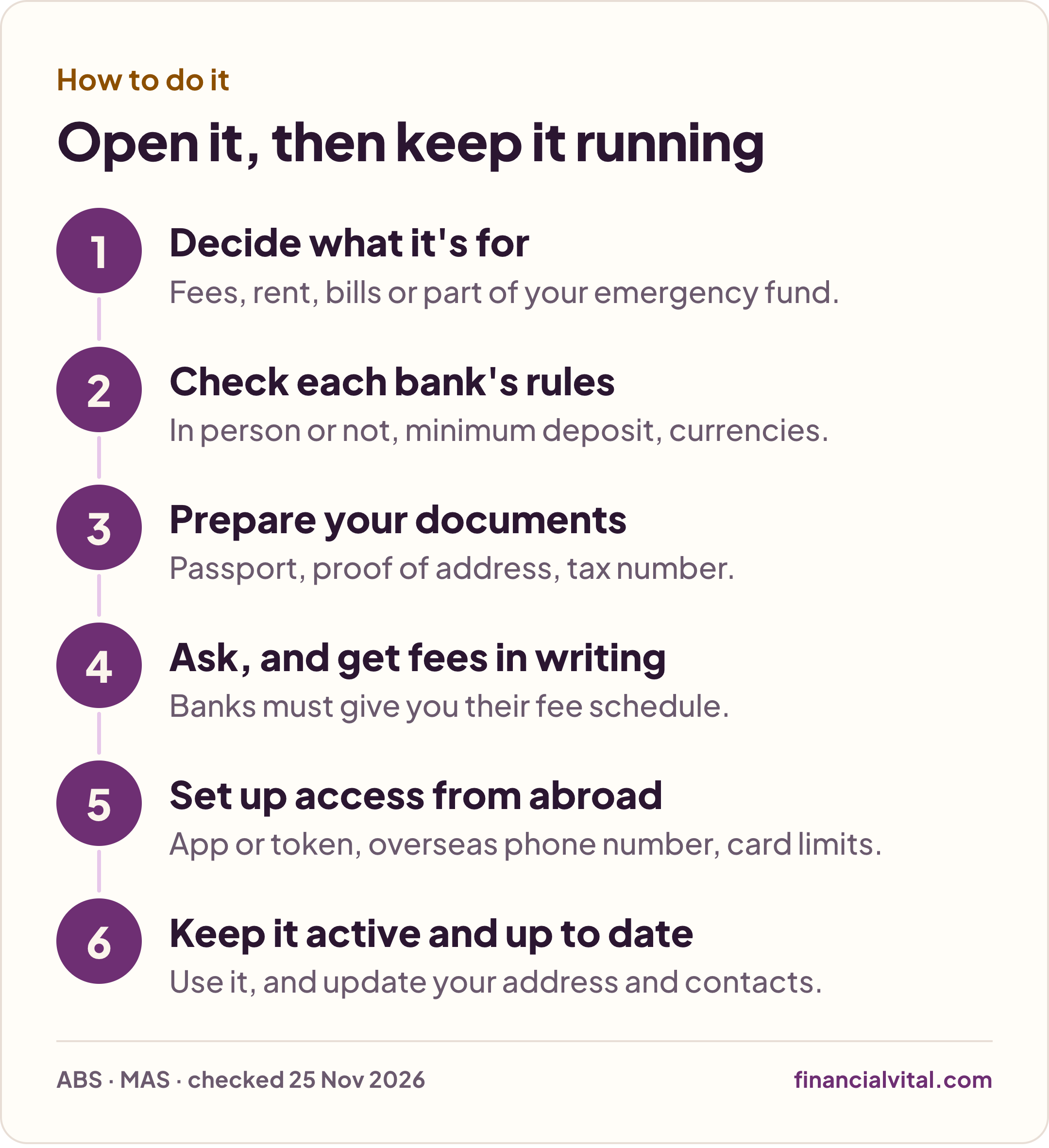
- Decide what the account is for. School fees, rent and bills, receiving income, or part of your emergency fund. This shapes which account you ask about.
- Check each bank’s own rules for non-residents. Whether you must open it in person in Singapore, the minimum deposit and balance, and which currencies it holds.
- Prepare your documents. Your passport, proof of your home address, your pass if you hold one, and your tax identification number for the tax residence form.
- Ask the questions below, and get the fees in writing. Banks in Singapore give customers a schedule of their fees and charges.
- Set up access from abroad. Online banking, the bank’s app or security token, a phone number that works overseas, and card limits for use outside Singapore.
- Keep the account active and up to date. Use it regularly, update your address and contact details when they change, and read the bank’s notices.
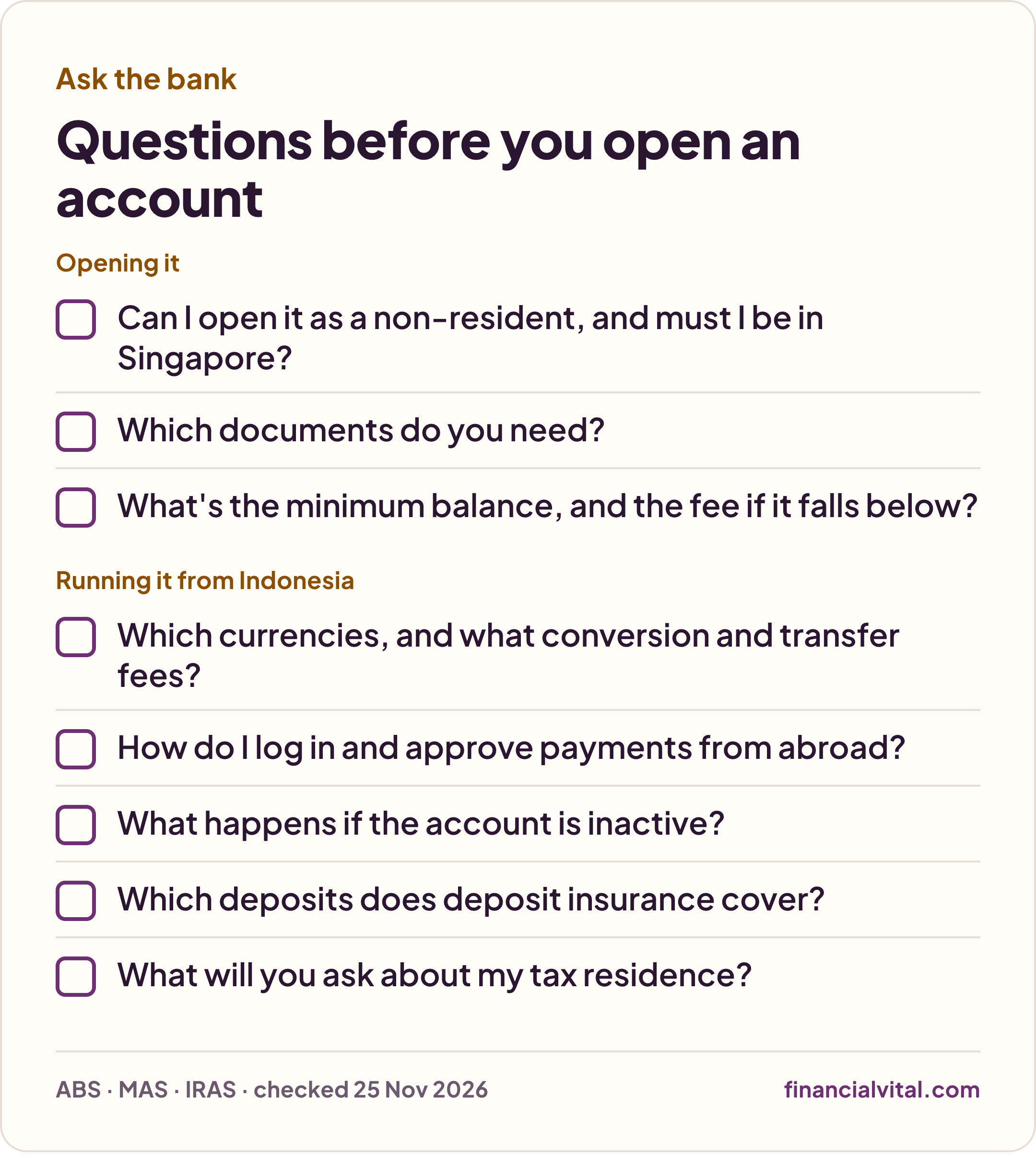
Questions to ask the bank
- Can I open this account as a non-resident, and do I need to be in Singapore to do it?
- Which documents do you need from me?
- What is the minimum balance, and what’s the fee if it falls below?
- Which currencies can it hold, and what are the conversion and transfer fees?
- How do I log in and approve payments from Indonesia?
- What happens if the account is inactive for a while?
- Which deposits in this account are covered by deposit insurance?
- What will you ask me about my tax residence?
Learn with others
Questions about managing money between Indonesia and Singapore? Join the Financial Vital community to learn alongside other Indonesian families and business owners.
Sources
All checked on 25 Nov 2026.
- MAS: Notice 626 on preventing money laundering (2022 amendment, PDF): banks must identify and verify each customer
- IRAS: Basic information for account holders of financial institutions: banks establish every account holder’s tax residence, usually with a self-certification form
- ABS: Code of Consumer Banking Practice (PDF): fee schedules; inactive and dormant accounts
- ABS: You and your bank (PDF): questions to ask your bank
- MoneySense: Understanding deposit insurance: Singapore-dollar deposits only, up to S$100,000 per depositor per bank