
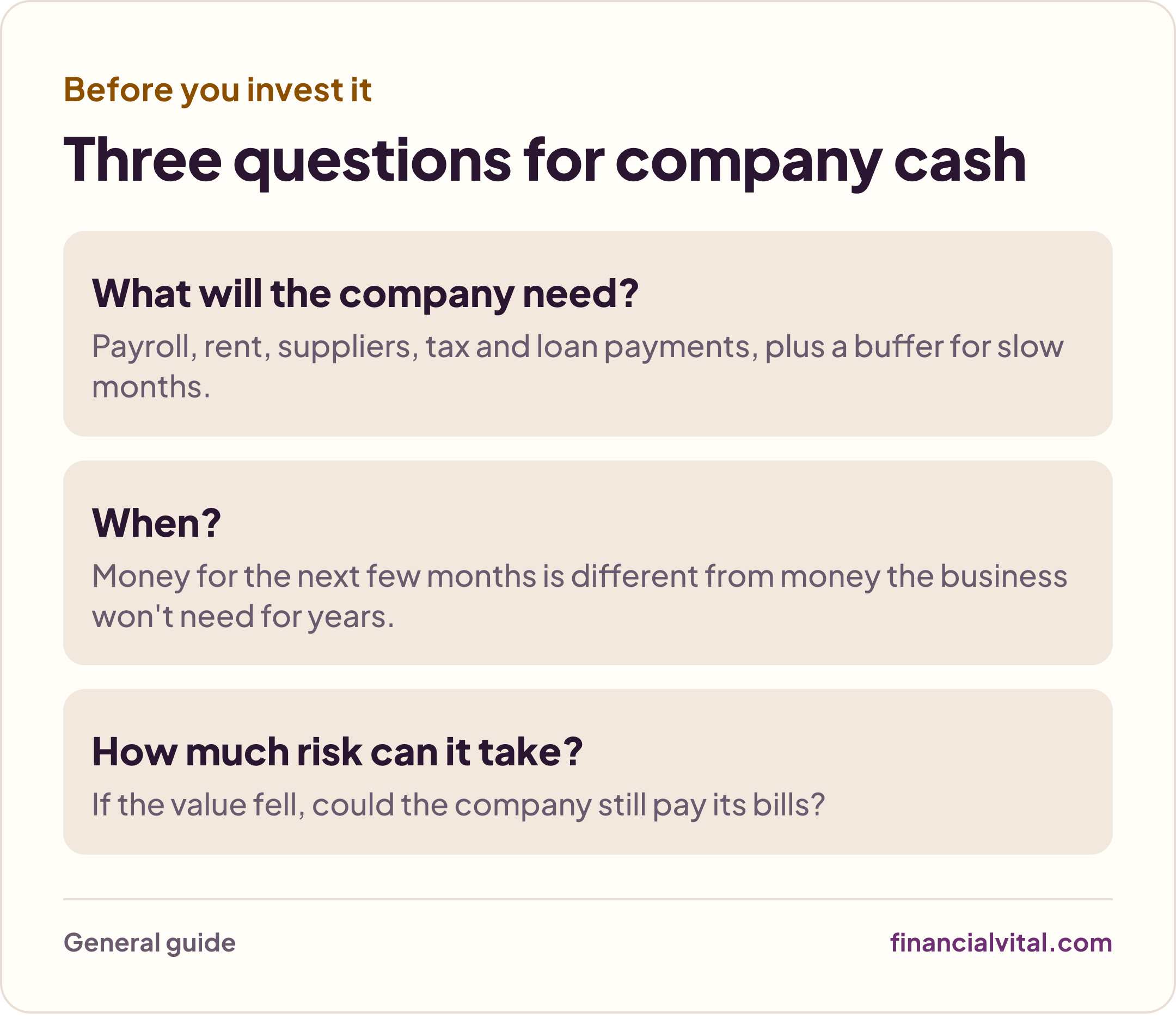
When a business has more cash than it needs right now, it’s tempting to put it to work. Before choosing where, match the cash to what the company will need, when it will need it, and how much risk it can take. Company money and personal money also work differently, in ways that matter.
What’s different in Singapore
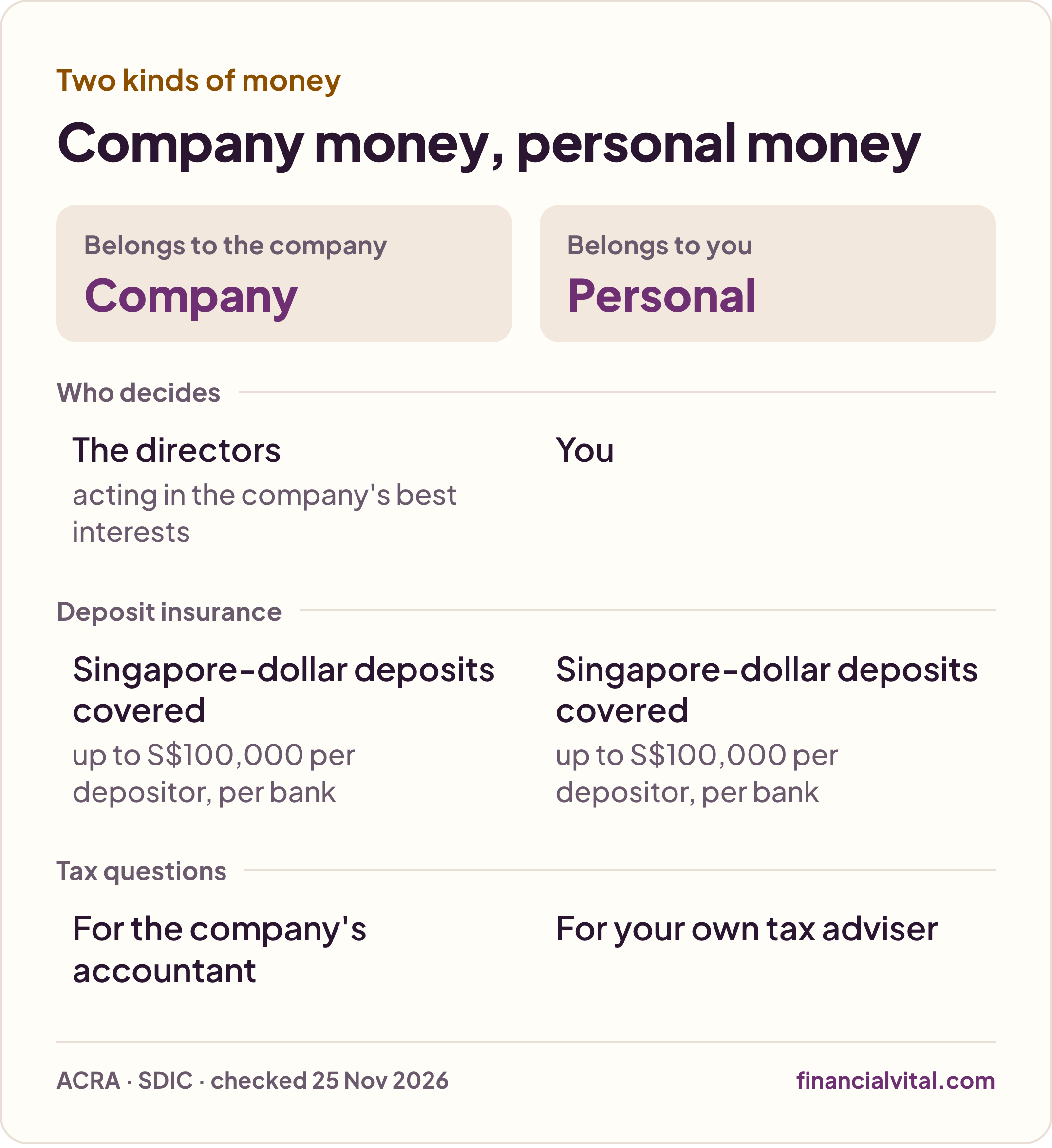
The company’s money is the company’s. A company is a separate legal entity, and ACRA notes that its directors must act in the company’s best interests, not the owners’ personal ones.
Deposit insurance covers companies too. Singapore’s deposit insurance scheme covers non-bank depositors, including companies, for Singapore-dollar deposits of up to S$100,000 per depositor at each member bank.
Investments can fall in value. MoneySense reminds investors that investments come with risks. Money the business will need soon is exposed if its value falls just before a bill is due.
Matching cash to needs
- Operating money. Payroll, rent, suppliers, tax and loan payments, plus a buffer for slow months.
- Planned spending. Equipment, expansion or a known payment in a year or two.
- Longer-term surplus. Money the business doesn’t expect to need for years.
Each part has a different time horizon, and so a different tolerance for risk. Higher potential returns come with higher risk covers the basics.
What this doesn’t do
It doesn’t recommend any product or predict returns. Tax questions, such as how a company’s investment income is treated, go to the company’s accountant. All investments carry risk, and the company could get back less than it put in.
Learn with others
Questions about managing money between Indonesia and Singapore? Join the Financial Vital community to learn alongside other Indonesian families and business owners.
Sources
All checked on 25 Nov 2026.
- ACRA: Choosing company directors and other key officers: directors must act in the company’s best interests
- GoBusiness: Start-up guide: a company keeps personal and business finances separate
- SDIC: Deposit insurance limit goes up to S$100,000 (PDF): covers non-bank depositors, including companies, up to S$100,000 per depositor
- MoneySense: What is investing?: investments come with risks
- MoneySense: Setting financial goals at every life stage: for shorter-term goals, low-risk and liquid options