
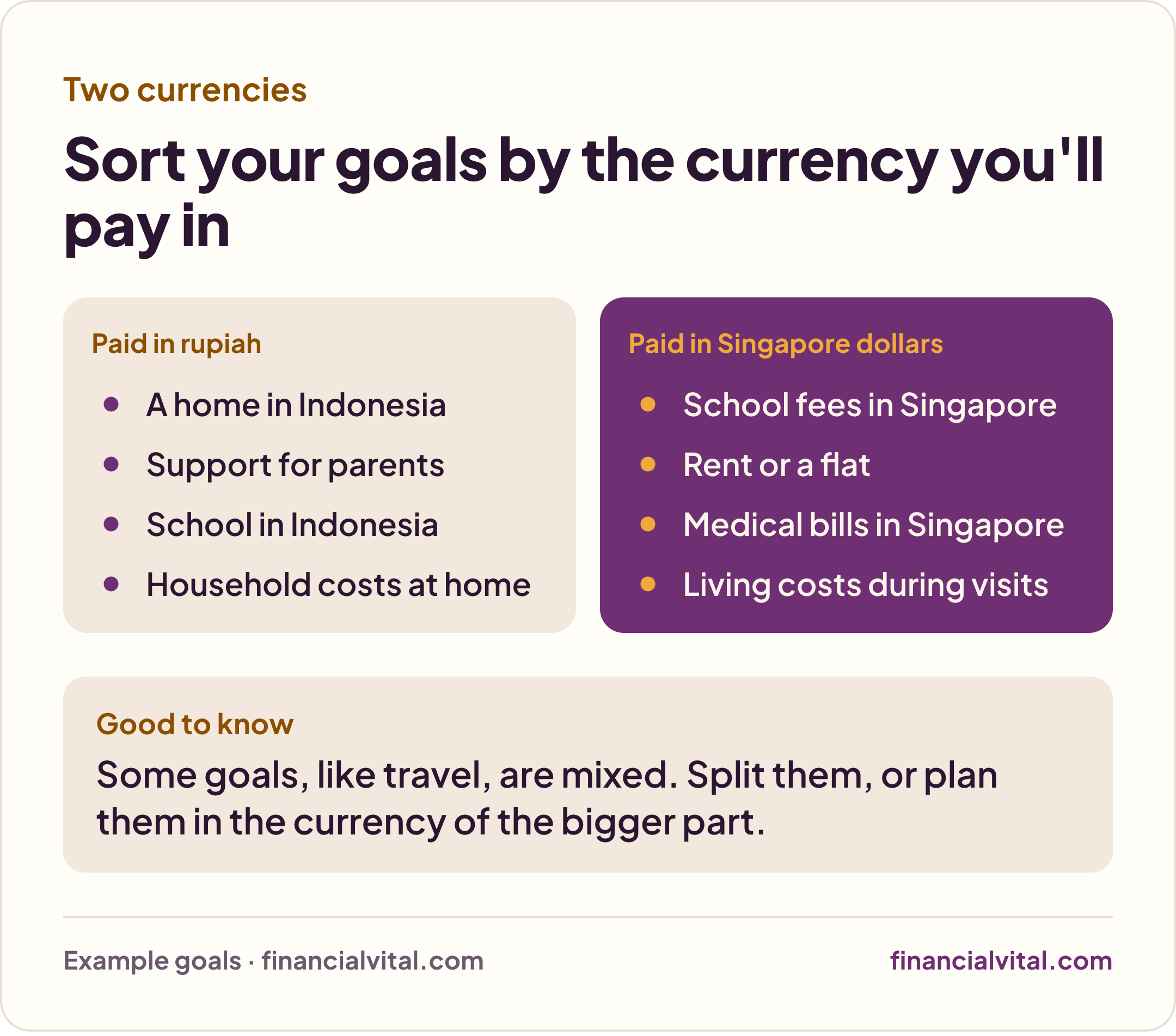
A family with a life in two countries usually has goals in two currencies. School fees and rent in Singapore are paid in Singapore dollars. A home, support for parents and many other plans in Indonesia are paid in rupiah. Measuring each goal in the currency it will be paid in shows how far along you really are, and how much exchange rates matter to the plan.
What’s different in Singapore
Most Singapore costs are priced and paid in Singapore dollars. If your income or savings are in rupiah, every Singapore cost depends on two numbers: its price in Singapore dollars, and the exchange rate on the day you pay.
The two currencies are also managed differently. Since 1981, the Monetary Authority of Singapore (MAS) has run monetary policy by managing the Singapore dollar against a basket of its trading partners’ currencies, within a band, rather than by setting interest rates. Bank Indonesia sets the BI-Rate and works to the inflation target set by the Indonesian government. The rate between the two currencies is set in the market and moves every day, in both directions.
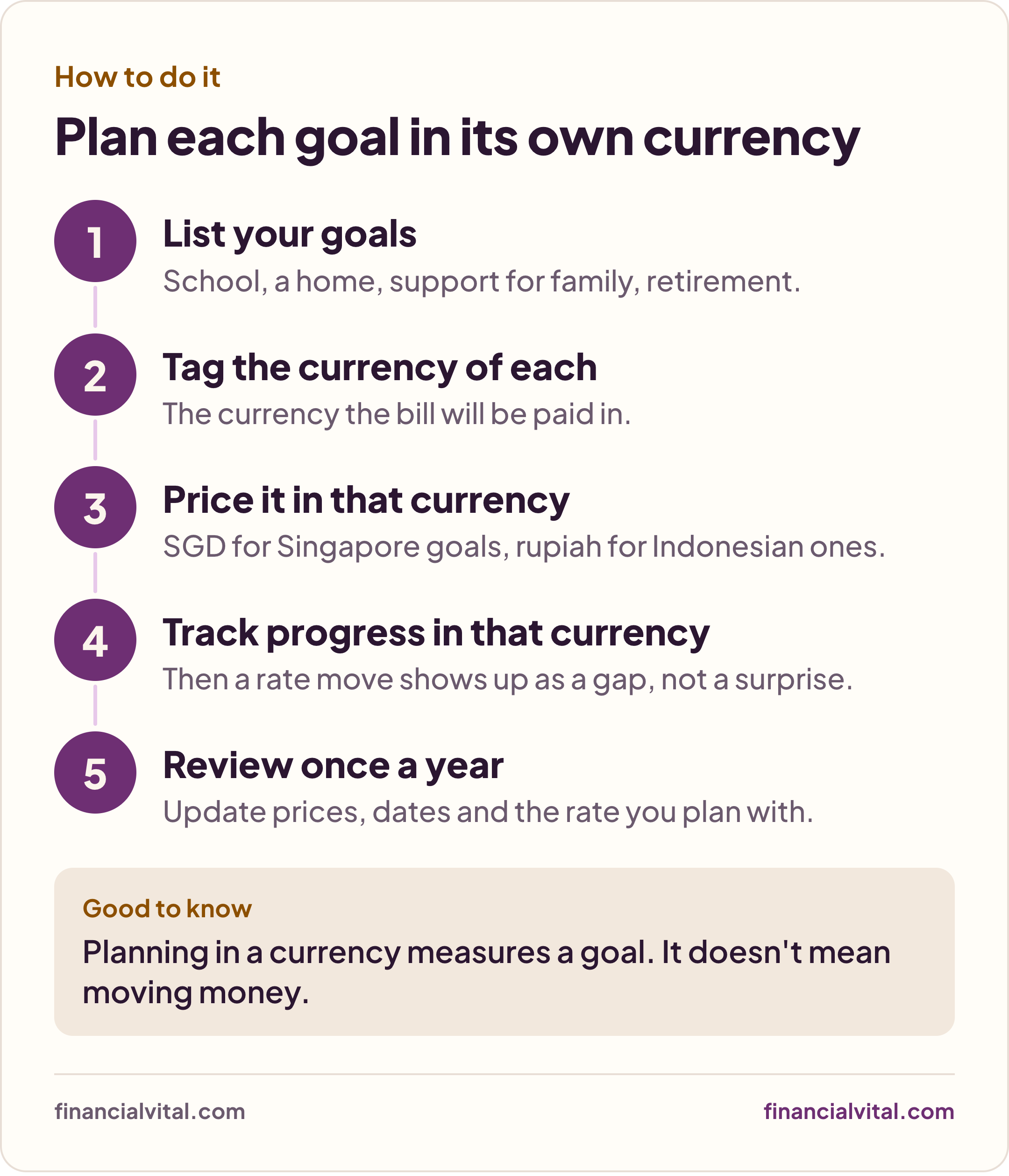
How to plan each goal in its own currency
- List your goals. School fees, rent or a flat in Singapore, a home in Indonesia, support for parents, retirement.
- Tag each goal with the currency it will be paid in. Most goals are clearly one or the other. Some, like travel, are mixed: split them, or plan them in the currency of the bigger part.
- Price each goal in that currency. Write the cost in Singapore dollars for Singapore goals, and in rupiah for Indonesian goals.
- Track progress in the same currency. Money set aside for a Singapore-dollar goal is easiest to follow in Singapore dollars.
- Review once a year. Update prices, dates and the exchange rate you use for planning.
What this doesn’t do
Planning in a currency is about measuring a goal. It isn’t about where your money is kept or moved. Holding money in another currency has its own costs and limits: banks charge a spread or a fee when you convert, and their rates differ from day to day and from bank to bank. In Singapore, deposit insurance covers Singapore-dollar deposits only (see Singapore insures SGD deposits only).
Nobody can tell you which way a currency will move. Naming the currency of each goal simply makes the effect of a move visible early, so you can adjust how much you save or when.
Learn with others
Questions about managing money between Indonesia and Singapore? Join the Financial Vital community to learn alongside other Indonesian families and business owners.
Sources
All checked on 25 Nov 2026.
- MAS: How does MAS carry out monetary policy?: the Singapore dollar is managed against a basket of currencies, within a band, since 1981
- MAS: What is MAS’ monetary policy framework and its rationale?: the exchange rate, not interest rates, as the target
- Bank Indonesia: Inflation: the government’s inflation target for 2025 to 2027
- Bank Indonesia: JISDOR, Non-USD/IDR Reference Rate and Transaction Rate: daily reference rates against the rupiah, the Singapore dollar included
- MoneySense: Understanding deposit insurance: foreign-currency deposits are not insured
- MoneySense: Understanding credit card interest and charges: exchange rates vary from day to day and from bank to bank