
When your life, income or business spans Singapore and Indonesia, tax questions can arise in both countries. Financial Vital doesn’t say how anything is taxed. This workflow helps you gather the facts and the right questions, so a tax adviser in each country can give you a clear answer.
Why both countries can be involved
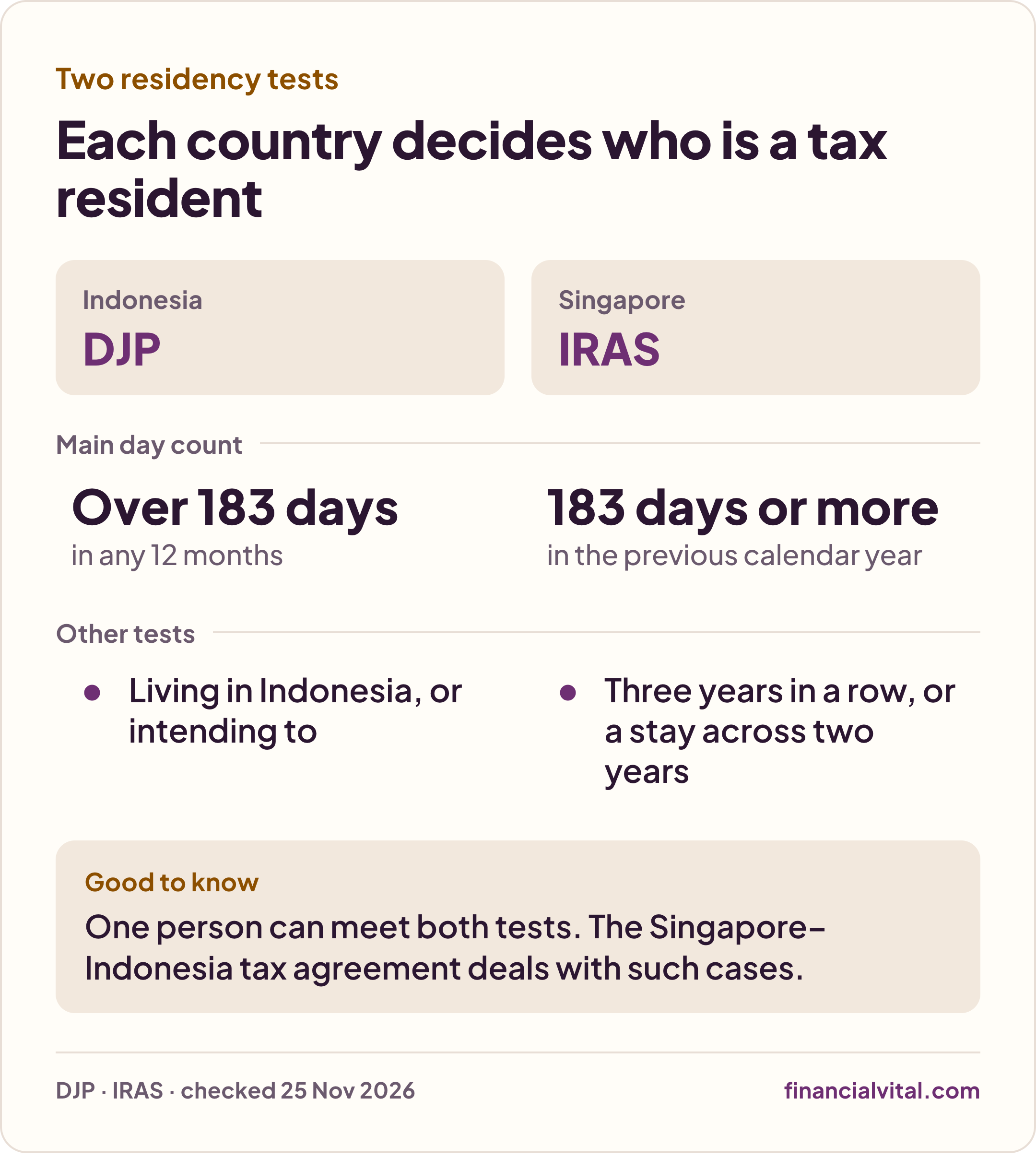
Each country has its own test for who counts as a tax resident. Singapore’s tax authority, IRAS, treats a foreigner as a tax resident for a year if, among other tests, they stayed or worked in Singapore for at least 183 days in the previous calendar year. Indonesia’s tax office treats a person as a domestic tax subject if, among other tests, they live in Indonesia or are there for more than 183 days in any 12 months.
Because the tests differ, one person can meet both, or neither. Singapore and Indonesia have a tax agreement for cases like this, and its updated version has applied since 1 January 2022. How it applies to you is a question for an adviser.
Step by step
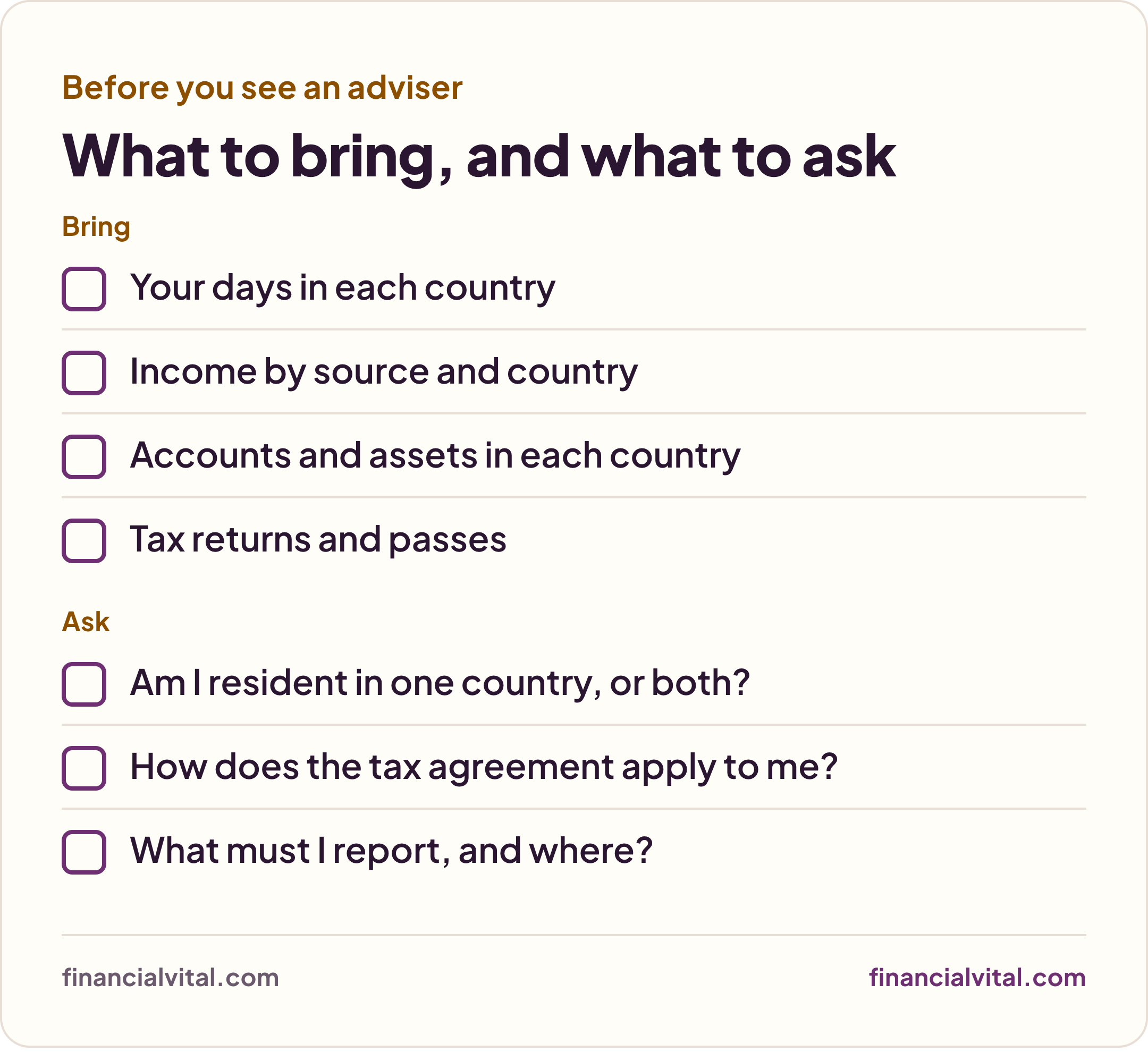
- Count your days. Note how many days you spent in each country last year and this year. Passport stamps, travel records and passes help.
- Map your income. List each kind of income and where it comes from: salary, business profits, rent, interest, dividends.
- List your accounts and assets. Bank accounts, investments, insurance policies and property, in each country.
- Gather your papers. Tax returns from both countries, work or residence passes, and statements.
- Write your questions. Start from the list below, and add your own.
- See an adviser in each country. A Singapore tax adviser for Singapore questions, and an Indonesian tax consultant for Indonesian ones. Ask each how the agreement between the two countries affects their answer.
- Keep a record. File the advice with your papers, and review it when your situation changes.
Questions to ask
- Am I a tax resident of Singapore, Indonesia or both this year?
- If both, how does the Singapore–Indonesia tax agreement apply to me?
- What do I need to report in Indonesia about accounts or assets I hold in Singapore?
- How does each country treat my income from the other?
- How are my spouse and children treated, including a child studying in Singapore?
- If I own a company in Singapore, how are director’s fees and dividends treated?
- What records should I keep, and for how long?
- What changes if I move, or spend more time in one country?
Learn with others
Questions about managing money between Indonesia and Singapore? Join the Financial Vital community to learn alongside other Indonesian families and business owners.
Sources
All checked on 25 Nov 2026.
- IRAS: Working out my tax residency: the tests for foreigners
- DJP: Regulation PER-23/PJ/2025 on domestic and foreign tax subjects: living in Indonesia, or more than 183 days in any 12 months (the page could not be opened on 25 Nov 2026; checked through its indexed text)
- IRAS: Updated Singapore-Indonesia agreement enters into force: in force from 23 July 2021
- IRAS: Singapore-Indonesia agreement (PDF): effective from 1 January 2022