An emergency fund is money you can reach quickly when something goes wrong: an illness, lost income, an urgent trip. For a family that lives across two countries, the questions are how much to keep, in which currency, and how fast you can get to it from either side.
What’s different for a two-country family
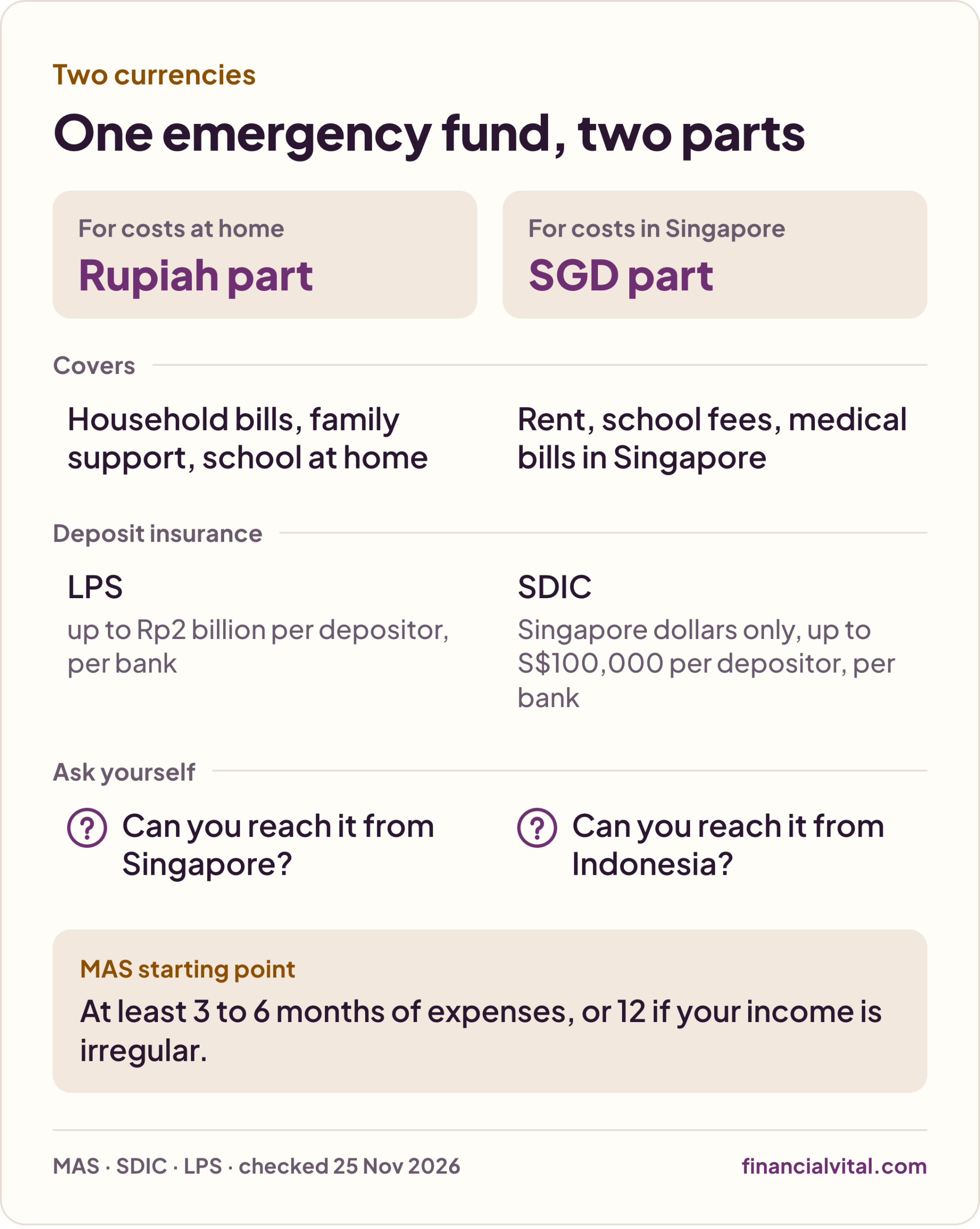
The Monetary Authority of Singapore’s Basic Financial Planning Guide suggests setting aside at least 3 to 6 months of expenses, or 12 months if your income is irregular. These are starting points written for Singaporeans. Your own number depends on your costs, your income and what you’re protecting against.
A two-country family has two extra questions. Costs fall in two currencies, so the fund needs to cover both. And an emergency can happen in either country, so each part needs to be reachable from the other side.
Deposit insurance works differently too. In Singapore it covers Singapore-dollar deposits only, up to S$100,000 per depositor at each bank. In Indonesia, LPS covers rupiah and foreign-currency deposits up to Rp2 billion per depositor at each bank, with conditions. See Singapore insures SGD deposits only for the details.
Step by step
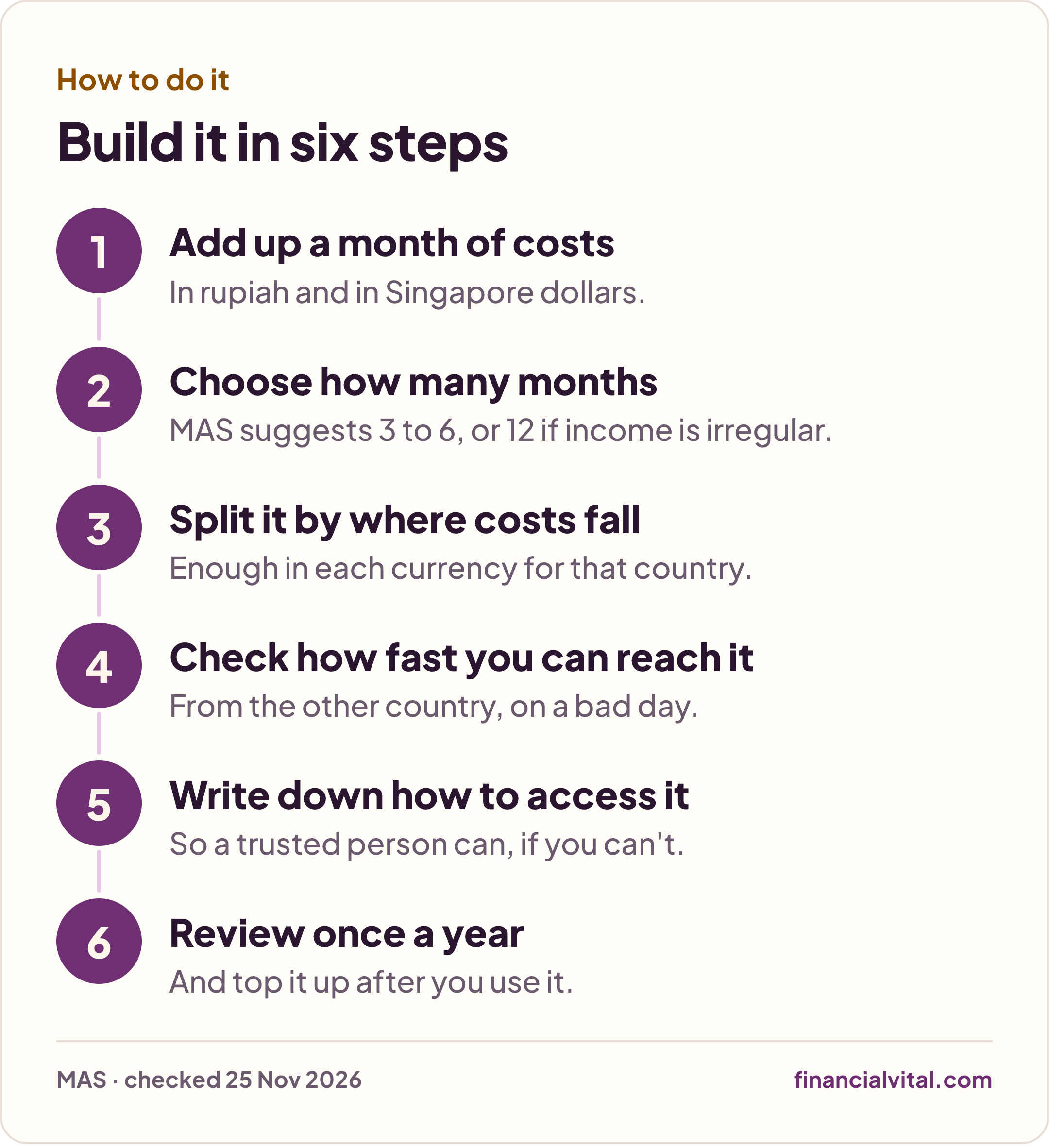
- Add up a month of essential costs in each currency. Rent, school fees, household bills, loan repayments, insurance premiums and taxes, in rupiah and in Singapore dollars.
- Choose how many months to cover. MAS suggests at least 3 to 6, or 12 if your income is irregular. Families who rely on one business or one income may want more.
- Split the fund by where the costs fall. Keep enough in each currency to cover that country’s months, so an emergency doesn’t force you to convert money in a hurry.
- Check how fast you can reach each part. Test it from the other country: online banking, cards, transfer times, daily limits, and whether the bank needs a local phone number for approvals.
- Write down how to access it. Tell a trusted family member where the fund is and how to reach it if you can’t.
- Review once a year, and top it up after you use it.
What an emergency fund isn’t
An emergency fund needs to be safe and easy to reach, so it isn’t the place for investments whose value can fall. Some insurance policies also pay you back only after you’ve paid a bill, so the fund can carry those costs until a claim comes through.
Learn with others
Questions about managing money between Indonesia and Singapore? Join the Financial Vital community to learn alongside other Indonesian families and business owners.
Sources
All checked on 25 Nov 2026.
- MAS: Basic Financial Planning Guide (PDF): at least 3 to 6 months of expenses, or 12 if income is irregular
- MoneySense: FAQs for consumers on basic financial planning (PDF): keep the fund readily accessible; reimbursement-based policies
- MoneySense: Basic Financial Planning Guide for fresh entrants to the workforce: what to count as monthly expenses
- MoneySense: Understanding deposit insurance: S$100,000 per depositor per bank; foreign-currency deposits not insured
- LPS: FAQ: Rp2 billion per depositor per bank