
If you hold assets in Singapore, such as a bank account, an insurance policy or property, they’ll go through Singapore’s own processes when you die. Planning for them in advance, alongside your planning at home, can spare your family a long and costly process in a second country.
What’s different in Singapore
Several routes, in a set order. MoneySense explains that assets can pass on death through probate, or through other means such as joint ownership and insurance nominations. CPF nominations, a trust nomination on an insurance policy and the right of survivorship on jointly held assets take precedence over a will.
Without a will, the law decides. If someone dies without a will, Singapore’s Intestate Succession Act decides who receives what. It doesn’t apply to Muslims: a Muslim’s estate is governed by Muslim law, and the beneficiaries apply to the Syariah Court for an Inheritance Certificate. For non-Muslims, the Public Trustee notes that movable property, such as money in a bank account, is distributed according to the law of the country where the person was domiciled at death.
Faith-based rules have their own limits. MUIS explains, for example, that a Muslim will (wasiat) can bequeath at most one-third of the estate.

Why Singapore assets need their own plan
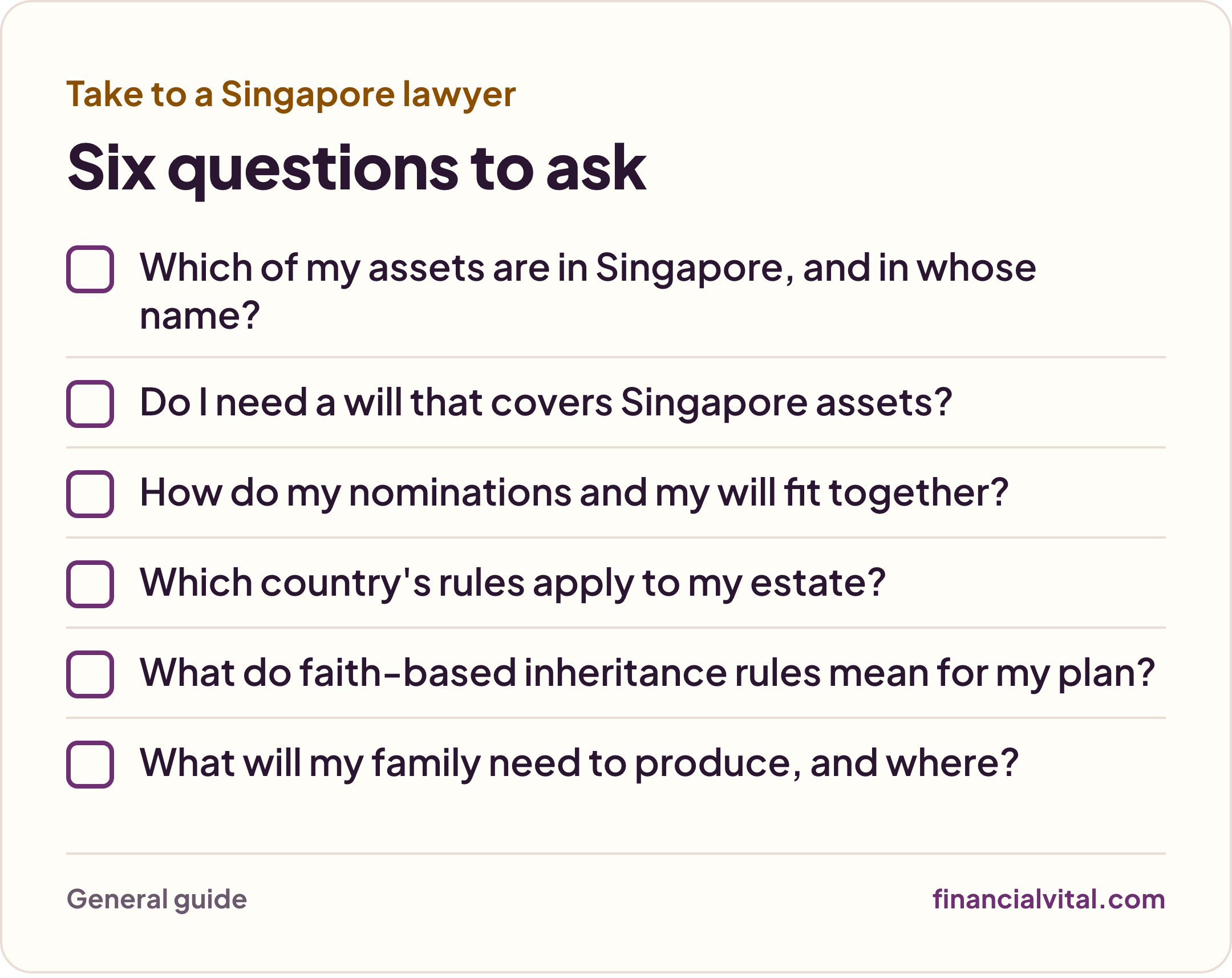
- Your family will need Singapore documents. An executor applies for a Grant of Probate to distribute the estate under a will. Without a will, the family applies for Letters of Administration.
- Nominations and wills interact. Some nominations override a will, and a later will can revoke a revocable nomination.
- Two countries, two sets of rules. Which rules apply can depend on where you’re domiciled, the type of asset and your faith.
What this doesn’t do
It isn’t legal advice. Estate planning across two countries needs a Singapore lawyer, and a specialist where faith-based inheritance rules apply. An adviser in Indonesia can cover the Indonesian side.
Learn with others
Questions about managing money between Indonesia and Singapore? Join the Financial Vital community to learn alongside other Indonesian families and business owners.
Sources
All checked on 25 Nov 2026.
- MoneySense: Deciding how to transfer your estate: transfer through probate, joint ownership and insurance nomination; CPF nominations and right of survivorship take precedence over a will
- MoneySense: Intestacy, what if you don’t have an estate plan?: the Intestate Succession Act doesn’t apply to Muslims; Muslim estates need an Inheritance Certificate
- MoneySense: What is probate?: Grant of Probate with a will; Letters of Administration without one
- Public Trustee’s Office: Estate (other assets): for non-Muslims, movable property follows the law of the country of domicile at death
- MUIS: Wasiat: a Muslim will can bequeath at most one-third of the estate
- Syariah Court: Inheritance overview: Inheritance Certificates under the Islamic law on inheritance
- LIA: Your guide to the nomination of insurance nominees (PDF, 2026): a will revokes an earlier revocable nomination